

This is going to be quite a read.
But if you’re a tenant, landlord, property owner, or simply someone planning to rent a home in Malaysia, don’t miss this one.
Because before you get the keys to your new home, you may be asked to pay several months’ worth of rental upfront.
You’ve found an apartment you like.
You’ve agreed on the rental.
You’re excited about moving in.
Then comes the payment request:
One month’s advance rental, two months’ security deposit and half a month’s utility deposit.
Wait.
That’s three and a half months’ worth of rental before you’ve even unpacked your first box.
And depending on the transaction arrangement, there may also be other amounts to consider, such as SST where applicable, and Tenancy Agreement stamping fees.
So why do Malaysian landlords ask for so much money upfront?
Where does the money go?
Who should you pay?
What happens if the tenancy is cancelled?
And perhaps most importantly:
Should you pay the money to the landlord, a real estate agency, a lawyer, or directly to the agent handling the property?
Let’s unpack all of that.
A quick note before we begin: This article discusses common deposit practices for residential property tenancies in Malaysia. Commercial properties may have very different deposit structures, payment arrangements and tenancy conditions. We'll explore commercial property deposits in a separate article.
The Famous “2 + 1 + half”
For residential properties in Malaysia, one of the most common industry practices is the familiar:
2 + 1 + 0.5
This generally means:
- 2 months’ Security Deposit
- 1 month’s Advance Rental
- 0.5 month’s Utility Deposit
This is a commonly used residential tenancy structure, but it should not be treated as a universal formula that automatically applies to every tenancy.
The actual deposit arrangement ultimately depends on the terms agreed between the landlord and tenant.
Let’s break it down.
Two Months’ Security Deposit
The security deposit is usually held throughout the tenancy.
It isn’t rent.
And it isn’t supposed to be treated as extra income for the landlord.
Its purpose is to provide protection if there are issues at the end of the tenancy.
Depending on the tenancy agreement, possible deductions may include:
- Outstanding rental
- Unpaid utility bills
- Missing keys, access cards or remotes
- Damage beyond normal wear and tear
- Repairs caused by negligence or misuse
- Other charges clearly provided for under the tenancy agreement
If the tenancy ends and there are no outstanding issues, the remaining deposit should be returned according to the terms of the tenancy agreement.
One Month’s Advance Rental
This part is much simpler.
You’re paying for your first month of occupation.
For example, if the monthly rental is RM2,500:
Advance Rental = RM2,500
This amount is used to offset the first month’s rental.
It is not a refundable deposit because it is payment for the period during which you are occupying the property.
Half a Month’s Utility Deposit
Electricity and water bills usually arrive after the services have already been used.
If a tenant moves out and leaves unpaid bills behind, somebody still has to settle them.
The utility deposit provides a buffer for outstanding charges such as:
- Electricity
- Water
- Sewerage
- Other agreed utility-related charges
Half a month’s rental is commonly used as the utility deposit for residential properties, although the actual amount can vary depending on the tenancy arrangement.
Think of it as a safety buffer rather than an extra fee.
A Simple Example
Let’s say you’re renting an apartment for RM2,500 per month.
Using the common 2 + 1 + 0.5 structure:
| Payment | Amount |
|---|---|
| 1 Month Advance Rental | RM2,500 |
| 2 Months Security Deposit | RM5,000 |
| 0.5 Month Utility Deposit | RM1,250 |
| Total | RM8,750 |
That’s three and a half months’ rental.
And that’s before considering any other applicable transaction costs, such as:
- SST, where applicable
- Tenancy Agreement stamping fees
- Other deposits or charges that have been clearly agreed
Renting isn’t just about whether you can afford the monthly rental.
It’s also about whether you have enough savings to cover the initial move.
And perhaps your first kettle.
And the One Month Earnest Deposit?
This is where many first-time tenants become confused.
When a tenant decides to proceed with a property represented by a real estate agency, the tenant may first be issued a Letter of Offer.
The tenant may then be required to pay one month’s earnest deposit.
Once the landlord accepts the offer and signs the Letter of Offer, the next steps can proceed, including the preparation of the Tenancy Agreement.
The important thing to understand is this:
The earnest deposit is not necessarily an additional fourth month of payment.
It is generally accounted for as part of the overall transaction amount, subject to the terms agreed in the Letter of Offer.
Using the RM2,500 example:
Total Residential Rental Payments
- 1 month’s Advance Rental: RM2,500
- 2 months’ Security Deposit: RM5,000
- 0.5 month’s Utility Deposit: RM1,250
Total: RM8,750
If the tenant has already paid RM2,500 as the earnest deposit, the balance payable before handover would generally account for that earlier payment.
The tenant may therefore need to prepare:
- 2 months’ Security Deposit
- 0.5 month’s Utility Deposit
- Any applicable SST, depending on the transaction arrangement
- Tenancy Agreement stamping fees
- Any other clearly agreed charges
The exact treatment of the earnest deposit should always be clearly stated in the Letter of Offer.
Where Does Your Deposit Go?
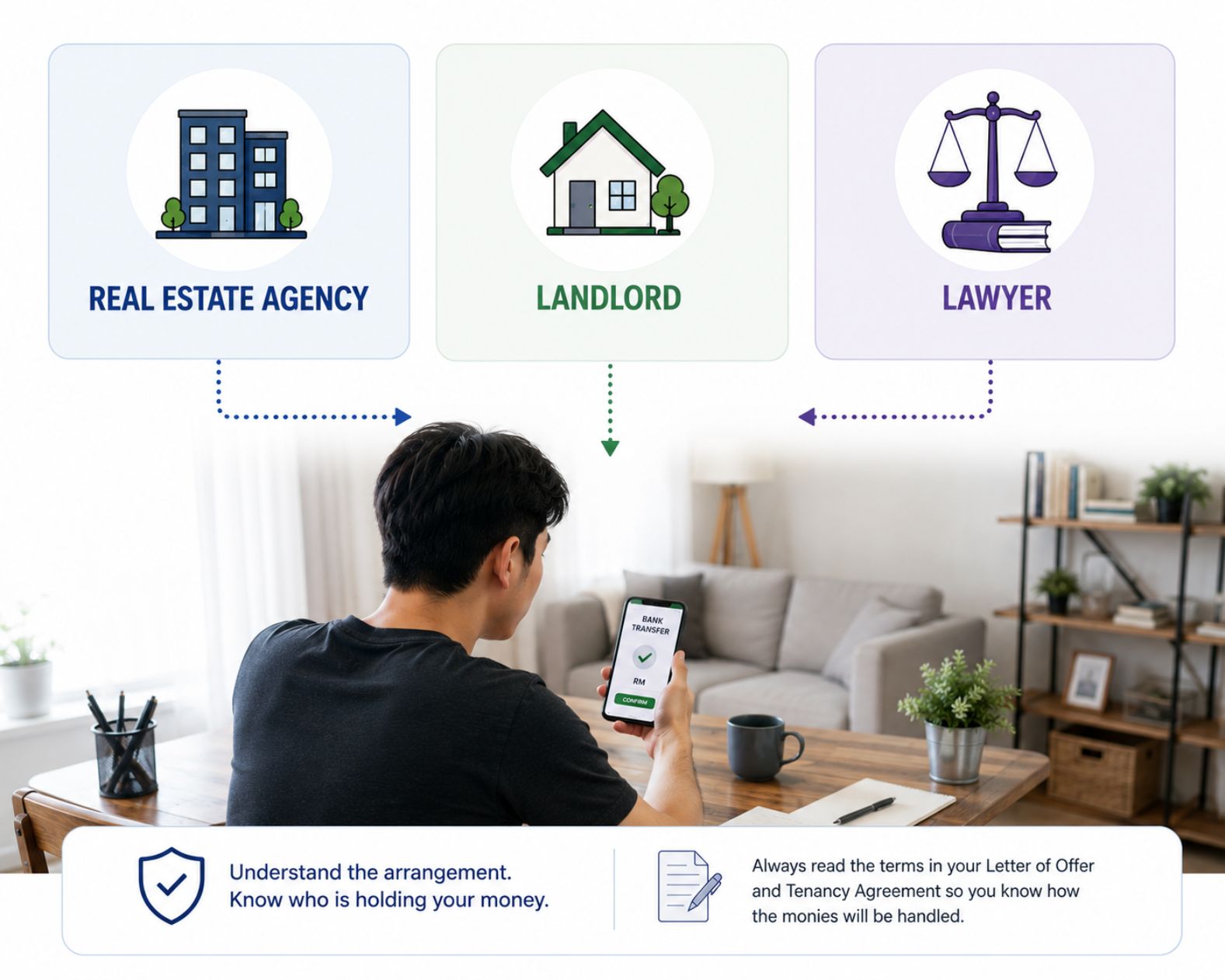
This is where things become particularly important.
There is more than one way rental deposits and other transaction monies can be handled.
Three possible arrangements include:
- The real estate agency acts as stakeholder
- The tenant pays the landlord directly
- A lawyer acts as stakeholder
Each arrangement has its own process and practical considerations.
The key question isn’t simply:
“Who gave me the bank account number?”
The more important question is:
“Who is authorised to receive this money, and in what capacity are they holding it?”
Agency as Stakeholder
In this arrangement, the relevant transaction monies are paid to the real estate agency.
The agency acts as a stakeholder for the transaction and handles the monies according to the agreed terms of the transaction.
The general process may look like this:
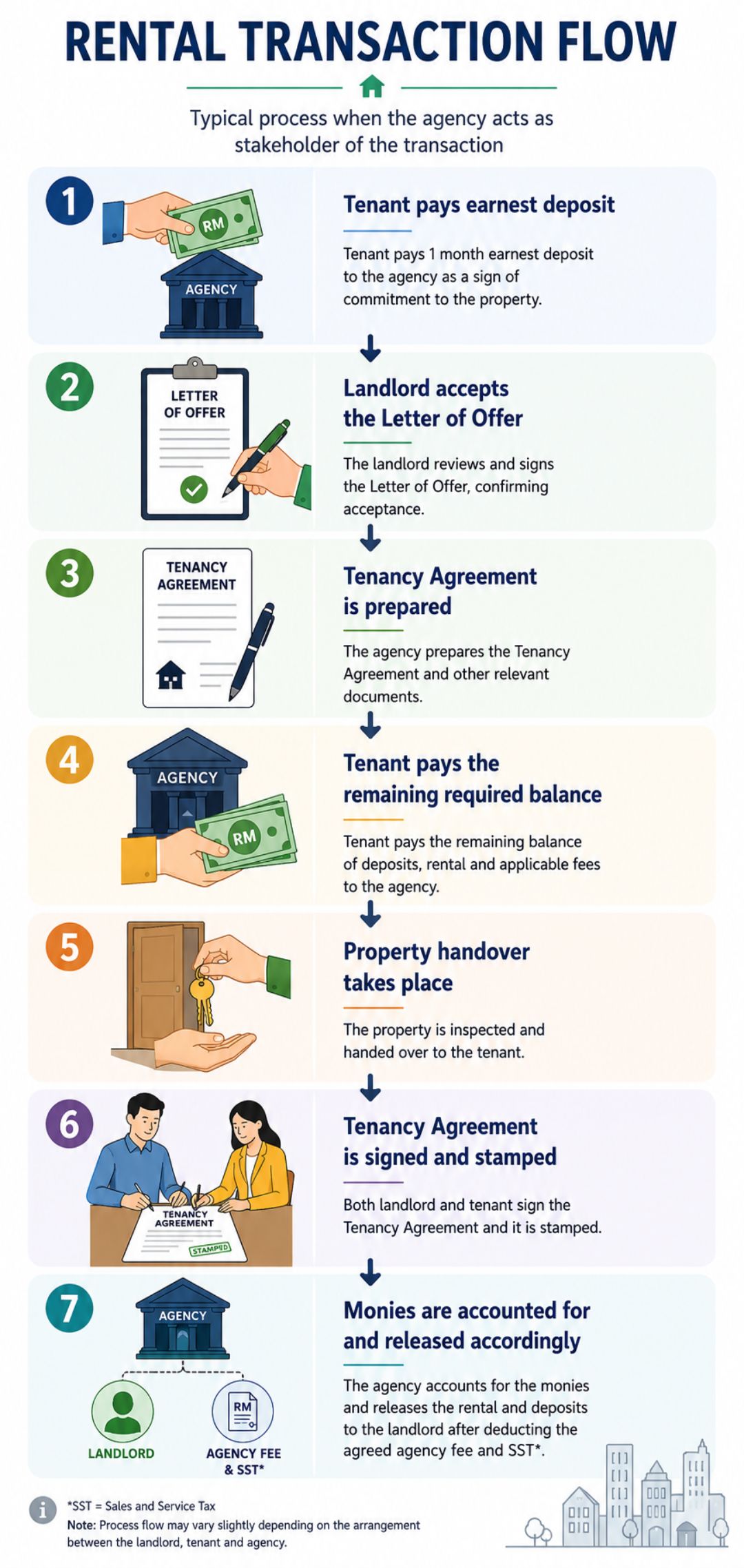
The Board of Valuers, Appraisers, Estate Agents and Property Managers, commonly known as LPPEH, regulates estate agency practice in Malaysia under the Valuers, Appraisers, Estate Agents and Property Managers Act 1981.
A properly structured stakeholder arrangement can create a clearer process for handling transaction monies.
How Does This Help the Tenant?
The money is not automatically treated as belonging to the landlord simply because the tenant has made the payment.
The agreed conditions of the transaction still need to be considered.
If the transaction proceeds successfully, the monies can be accounted for and released according to the agreed arrangement.
If there is a cancellation, the stakeholder can refer to the agreed cancellation terms and conditions when determining how the monies should be handled.
How Does This Help the Landlord?
The landlord has a professional intermediary handling and documenting the transaction monies.
This can create a clearer payment trail and reduce confusion over:
- Whether payment has been made
- How much has been paid
- What each payment represents
- When the money should be released
How Does This Help the Agency?
The agency is not merely passing money from one party to another.
Where acting as stakeholder, the agency handles the transaction monies according to the agreed terms and documented process.
This can provide a more objective framework if a transaction does not proceed as planned.
What Happens If the Transaction Is Cancelled?
This is one of the most important reasons to clearly document the stakeholder arrangement.
The money does not automatically belong to the tenant simply because the tenant paid it.
Neither does it automatically belong to the landlord simply because the property belongs to the landlord.
The handling of the monies should follow the agreed cancellation terms and conditions.
Depending on those terms and the circumstances of the cancellation, the monies can then be returned or released to the respective parties accordingly.
This can help reduce unnecessary delays and disagreements between landlord and tenant because the party holding the money has a documented basis for dealing with it.
Of course, if there is a genuine dispute about the interpretation of the agreement or entitlement to the money, the matter may still require further resolution between the parties.
Lawyer as Stakeholder
Another possible arrangement is for the landlord to request that the tenant pays the relevant monies directly into the landlord’s account.
The process may look like this:
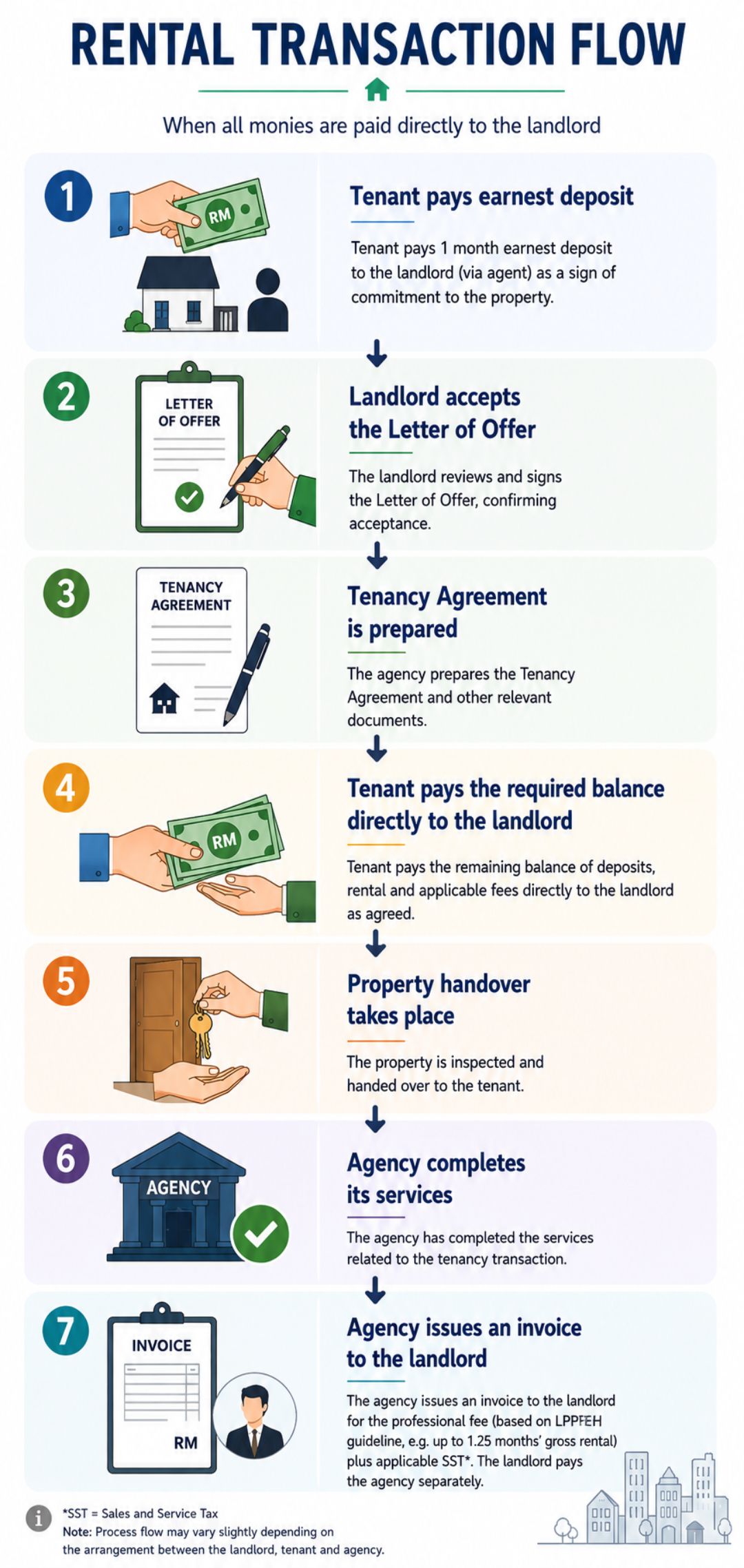
The landlord then pays the agency separately for the professional services rendered.
According to LPPEH’s published scale of fees, the maximum estate agency fee for a letting of up to three years is equivalent to 1.25 months’ gross rental.
The agency’s applicable SST treatment is a separate matter from the tenant’s rental deposits and should be clearly explained according to the actual transaction arrangement.
Advantages of Direct Payment to the Landlord
For some transactions, the arrangement may be straightforward.
The landlord receives the rental and deposits directly, while the agency separately bills the landlord for its professional services.
There may also be fewer parties physically holding the transaction monies.
Things to Consider
Once the money has been paid directly to the landlord, the agency is no longer holding those particular monies as stakeholder.
If the transaction is cancelled or a disagreement arises before completion, the handling and return of the money will depend more directly on the landlord, tenant and the terms they have agreed to.
This makes the Letter of Offer particularly important.
Both parties should clearly understand:
- What happens if the tenant cancels
- What happens if the landlord cancels
- Whether the earnest deposit is refundable
- Whether any amount can be forfeited
- Under what circumstances deductions may be made
- When refundable monies must be returned
Clear written terms are far easier to follow than trying to reconstruct a verbal conversation after a disagreement.
A Lawyer Acts as Stakeholder

Another possible arrangement is for the relevant monies to be paid to a lawyer acting as stakeholder.
The lawyer holds the money according to the agreed terms of stakeholding and releases it when the relevant conditions have been met.
The Malaysian Bar’s published ruling on stakeholders states that a solicitor acting as stakeholder for two or more parties must “strictly adhere to the terms of the stakeholding.”
It also states that stakeholder money should not be released or otherwise dealt with except in accordance with the stakeholding terms or with the express written consent of the relevant parties.
Advantages of Using a Lawyer as Stakeholder
Clear Stake holding Terms
The arrangement can be documented with clear instructions on:
- What money is being held
- Who the money belongs to
- When the money may be released
- What happens if the tenancy does not proceed
Professional Client-Money Framework
Solicitors handling client or stakeholder money are subject to professional rules relating to the handling of client money.
The Malaysian Bar’s Solicitors’ Accounts Rules define client money to include money received or held by a solicitor in connection with their practice, including money held as stakeholder.
Useful for More Complex Arrangements
A lawyer acting as stakeholder may be useful where the transaction involves more detailed contractual arrangements or where the parties want legal documentation and stakeholding arrangements to be coordinated.
Things to Consider
A solicitor may charge a fee for acting as stakeholder.
The Malaysian Bar’s published stakeholder ruling states that a solicitor is entitled to charge a fair and reasonable fee for acting in that capacity.
The parties should also clearly understand:
- Who the lawyer is acting for
- Whether the lawyer is acting only as stakeholder or also providing legal services
- What monies are being held
- The conditions for release
- What happens in the event of cancellation
- What fees may apply
A Very Important Warning
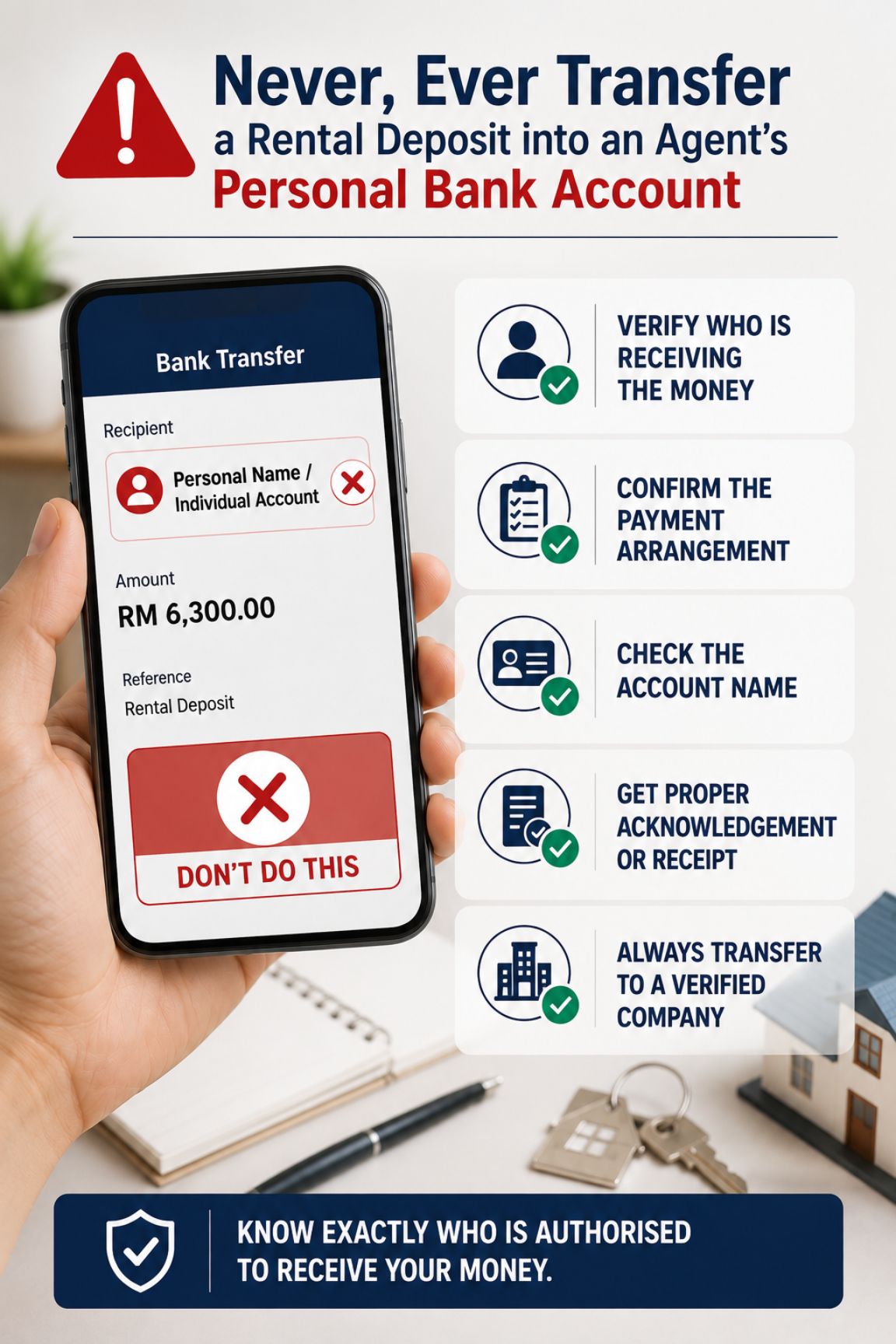
This is worth repeating.
Never, ever casually transfer your rental deposit into an individual agent’s personal bank account.
If you are dealing with a real estate agency, understand exactly who is receiving the money and why.
Depending on the transaction arrangement, payment may legitimately be made to:
- The real estate agency, where the agency is authorised to receive and handle the monies
- The landlord, where direct payment has been agreed
- A lawyer acting as stakeholder
But that is very different from simply transferring money into the personal bank account of an individual agent because you received the account number through WhatsApp.
Before making any payment, verify:
- The name of the person or organisation receiving the money
- Why they are receiving it
- Whether they are receiving it as landlord, agency or stakeholder
- The bank account name
- The payment instructions
- That the instructions have been properly verified
- That you will receive proper acknowledgement or a receipt
A real estate negotiator and a registered real estate agency are not the same thing.
The safest question to ask is:
“Who is legally and properly authorised to receive this money?”
Don’t just transfer first and ask questions later.
Can a Landlord Ask for More Than 2 + 1 + 0.5?
Yes, a landlord and tenant may agree to a different deposit arrangement.
The familiar 2 + 1 + 0.5 structure is a common residential industry practice, but not every tenancy must follow exactly the same formula.
There may be situations where an additional deposit is requested.
For example:
- The property is fully furnished with valuable furniture or appliances
- The tenant has pets and a separate pet deposit is agreed
- Additional access cards or parking remotes are provided
- The tenant requests permission to make alterations
- There are special arrangements that create additional responsibilities or risks
The important question isn’t simply:
“Why is the landlord asking for more?”
Ask instead:
“What exactly is this additional deposit for?”
Every additional payment should be clearly identified.
For example:
Pet Deposit: RM2,000, refundable subject to the terms of the tenancy agreement
is much clearer than:
Additional Deposit: RM2,000
Before paying, the tenant should know:
- What the money is for
- Whether it is refundable
- When it should be returned
- What deductions may be made
- Whether the amount is clearly stated in the agreement
Can a Landlord Keep Your Deposit?
Not automatically.
A security deposit is not a blank cheque.
The tenancy agreement should provide the basis for deductions.
Possible deductions may include:
- Outstanding rental
- Unpaid utility bills
- Missing access cards, keys or remotes
- Damage beyond normal wear and tear
- Repairs caused by negligence
- Other agreed charges clearly stated in the tenancy agreement
The key phrase here is:
Beyond Normal Wear and Tear
A property naturally ages.
People live in it.
Paint fades.
Appliances grow older.
Things experience ordinary use.
Normal Wear and Tear May Include:
- Paint gradually fading over time
- Minor marks from ordinary use
- General ageing of fixtures
- Appliances deteriorating through normal usage
Potentially Chargeable Damage May Include:
- Large holes in walls
- Broken fixtures caused by misuse
- Serious burns or stains
- Missing inventory items
- Damage caused by negligence
A five-year-old paint job becoming dull is not necessarily the same thing as someone punching a hole through the wall.
Take Photos Before Moving In
Before collecting the keys, take photographs and videos of the property.
Document:
- Walls
- Flooring
- Furniture
- Appliances
- Air-conditioners
- Bathrooms
- Existing scratches or damage
- Access cards
- Keys
- Parking remotes
If possible, use an inventory and condition list.
It may feel unnecessary when you’re excited about moving into your new home.
Sixteen months later, when someone is trying to remember whether that scratch on the wardrobe was already there, you’ll probably be glad you did.
Don’t Forget the Tenancy Agreement
Every tenancy agreement is different.
Some landlords may include requirements relating to:
- Cleaning before moving out
- Air-conditioner servicing
- Replacement of lost access cards
- Replacement of parking remotes
- Pet-related responsibilities
- Repairs and maintenance
- Utilities
- Internet services
- Other property-specific conditions
These aren’t necessarily hidden charges if they are clearly stated and agreed upon.
The problem is that many people don’t read the tenancy agreement carefully until something goes wrong.
By then, the agreement suddenly becomes extremely interesting reading.
What About Stamp Duty?
A tenancy or lease agreement may be subject to stamp duty under the Stamp Act 1949.
The Inland Revenue Board of Malaysia explains that documents relating to leases and rentals can fall within the scope of stamp duty, with the applicable amount depending on the contents and nature of the instrument.
Malaysia has also moved toward its stamp duty self-assessment system, known as STSDS, for relevant instruments and transactions.
The actual stamping requirements and amount should be confirmed based on the tenancy agreement and the applicable law and procedures at the time.
Tips for Tenants
Before paying any rental deposit:
- View the actual unit whenever possible.
- Check that appliances are working.
- Read the Letter of Offer carefully.
- Understand what happens to the earnest deposit.
- Ask for a complete breakdown of every amount payable.
- Confirm who is authorised to receive the money.
- Verify bank account details before transferring funds.
- Never casually transfer a deposit to an agent’s personal account.
- Keep all receipts and proof of payment.
- Photograph the property’s condition before moving in.
- Read the Tenancy Agreement before signing.
- Understand the conditions for deposit deductions and refunds.
Most importantly:
Don’t transfer a large amount of money until you understand what every ringgit is for and who is holding it.
Tips for Landlords
Deposits are there to provide reasonable protection.
They shouldn’t become a source of unnecessary confusion.
Landlords can help prevent future disputes by:
- Clearly explaining every deposit requested
- Using a proper Letter of Offer
- Clearly stating cancellation terms
- Preparing a proper inventory list
- Documenting the property’s condition
- Keeping clear records of payments
- Clearly explaining who receives the transaction monies
- Stating the basis for any deposit deductions
- Following the agreed process for returning refundable monies
Clear communication usually costs nothing.
Disputes can cost everyone.
Final Thoughts
Rental deposits can feel overwhelming, especially if you’re renting your first home.
When someone says:
“You need to pay 2 + 1 + 0.5.”
It can sound like someone has invented a new branch of Malaysian mathematics.
But once you understand the breakdown, it starts to make sense.
Generally, the common residential structure involves:
- 1 month’s advance rental
- 2 months’ security deposit
- 0.5 month’s utility deposit
The one month’s earnest deposit paid earlier may form part of the overall transaction amount, depending on the agreed terms.
There may also be:
- SST where applicable and depending on the transaction arrangement
- Tenancy Agreement stamping fees
- Other clearly identified and agreed deposits
But understanding how much you need to pay is only half the story.
You should also understand:
- Who are you paying?
- Why are they receiving the money?
- Are they holding it as landlord, agency or stakeholder?
- What happens if the transaction is cancelled?
And perhaps most importantly:
Never transfer a rental deposit simply because someone sent you a bank account number.
Whether the monies are held by a real estate agency acting as stakeholder, paid directly to the landlord, or held by a lawyer acting as stakeholder, the arrangement should be clear, documented and understood by everyone involved.
Because at the end of the day, a smooth tenancy doesn’t begin when you receive the keys.
It begins much earlier.
With clear terms.
Clear payment instructions.
Proper documentation.
And a clear understanding of where your money is going.
Disclaimer
This article is intended for general information and educational purposes only. It discusses common residential tenancy practices and possible arrangements for handling rental deposits in Malaysia. It is not legal, tax, financial or professional advice, and it should not be treated as a substitute for advice based on the specific facts of an individual transaction.
Deposit structures, stakeholder arrangements, agency fees, SST treatment, stamp duty and the rights and obligations of landlords and tenants may depend on the terms of the relevant documents, the nature of the transaction and applicable laws and regulations.
Where there is uncertainty, disagreement or a significant financial commitment, readers should seek appropriate advice from a qualified lawyer, licensed or registered property professional, tax professional or the relevant authority.