
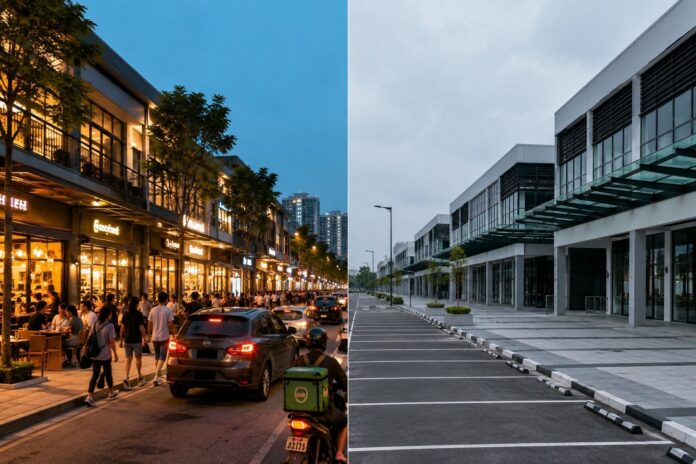
Beautiful buildings don’t guarantee busy businesses. Human behaviour does.
There is a moment I have started noticing whenever I visit a commercial development.
I arrive, park the car, and walk towards the shops.
The buildings look good.
The landscaping is neat. The shopfronts are nicely renovated. There are cafés, restaurants, convenience stores and service businesses. Maybe there is even a beautifully designed central plaza with trees, benches and expensive-looking lighting.
On paper, everything seems right.
Yet somehow, the place feels… quiet.
Not peaceful.
Quiet.
The kind of quiet where you start wondering whether anyone actually comes here unless they have a specific appointment.
Then, somewhere else, you might find an older row of shoplots that looks far less impressive.
The buildings may be tired. The signage may not match. The architecture certainly won’t be winning any design awards.
But people are everywhere.
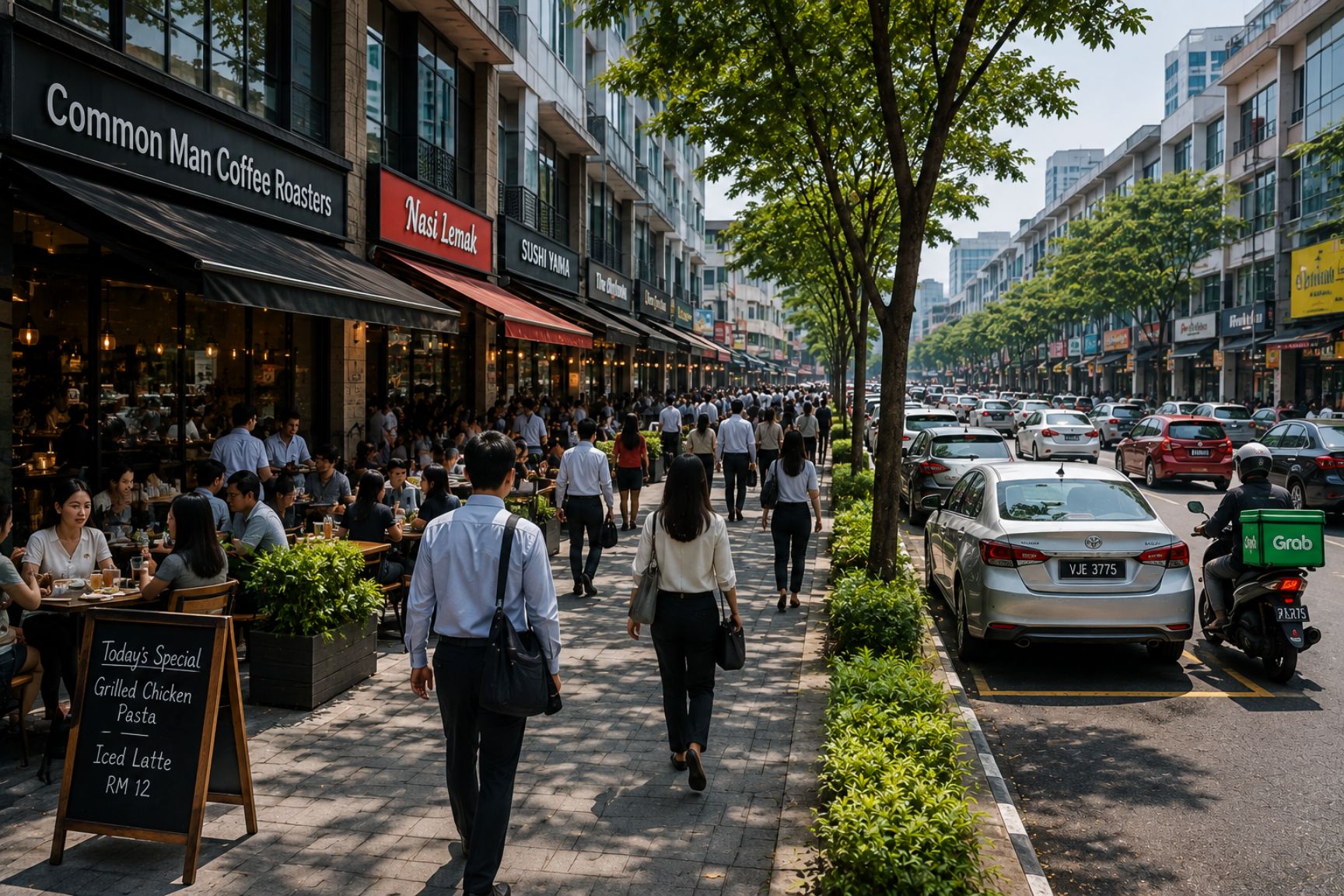
Someone is grabbing takeaway.
A family is looking for a table.
A delivery rider is waiting outside a restaurant.
An office worker is walking back with a cup of coffee.
Cars are coming and going.
People park, walk, eat, shop, leave and come back again.
And that’s when an interesting question begins to emerge:
Why do some commercial hubs naturally come alive while others struggle to create the same energy?
The answer is usually more complicated than simply saying, “It’s the location.”
Commercial Property Is Really About Human Behaviour
Property brochures tend to describe commercial developments using familiar words.
“Strategic location.”
“High visibility.”
“Excellent accessibility.”
“Vibrant commercial hub.”
“Integrated lifestyle destination.”
After you’ve seen enough brochures, they can start sounding like variations of the same sentence.
But property doesn’t operate according to brochures.
It operates according to people.
Where they live.
Where they work.
Where they park.
Where they walk.
Where they eat.
Where they stop.
And, perhaps most importantly, where they are willing to come back repeatedly.
That last part is crucial.
A commercial area doesn’t become successful simply because people visit once.
It becomes successful when people develop habits around it.
The coffee run before work.
The same lunch restaurant every Tuesday.
The convenience store on the way home.
The clinic appointment nearby.
The gym after work.
The family dinner on Friday.
The quick takeaway before heading home.
Successful commercial hubs become woven into people’s routines.
The struggling ones often remain places people visit only when they have a specific reason.
That’s a very different kind of traffic.
The Destination Trap
One of the biggest assumptions in commercial property is that people will happily make a special trip just because a development is attractive.
Sometimes they will.
But most of the time, people prefer convenience.
Think about your own behaviour.
You finish work and want coffee.
There are two cafés.
One is 300 metres away, with easy parking.
The other has better décor, better Instagram photos and perhaps even better coffee, but requires another turn, a search for parking and a short walk in Malaysia’s afternoon heat.
Which one are you more likely to visit on an ordinary Tuesday?
Probably the convenient one.
That’s because most daily purchases aren’t major decisions.
People are constantly making tiny calculations without consciously thinking about them.
How far?
How long?
Where do I park?
Is it easy to get in?
Can I get out quickly?
Is there somewhere nearby?
Do I really need to make another trip?
This is the destination trap.
A development may be marketed as a destination, but that doesn’t mean people will naturally make it one.
The strongest commercial hubs often don’t need to persuade people to visit.
People are already passing through.
Office workers are nearby.
Residents live upstairs or across the road.
Students are moving through the area.
Parents are dropping off children.
Commuters are heading home.
Grab drivers are collecting passengers.
People are already moving.
The commercial component simply captures some of that movement.
That is a very powerful advantage.
Parking Is Part of the Product
There is another lesson you can learn very quickly by visiting a commercial area:
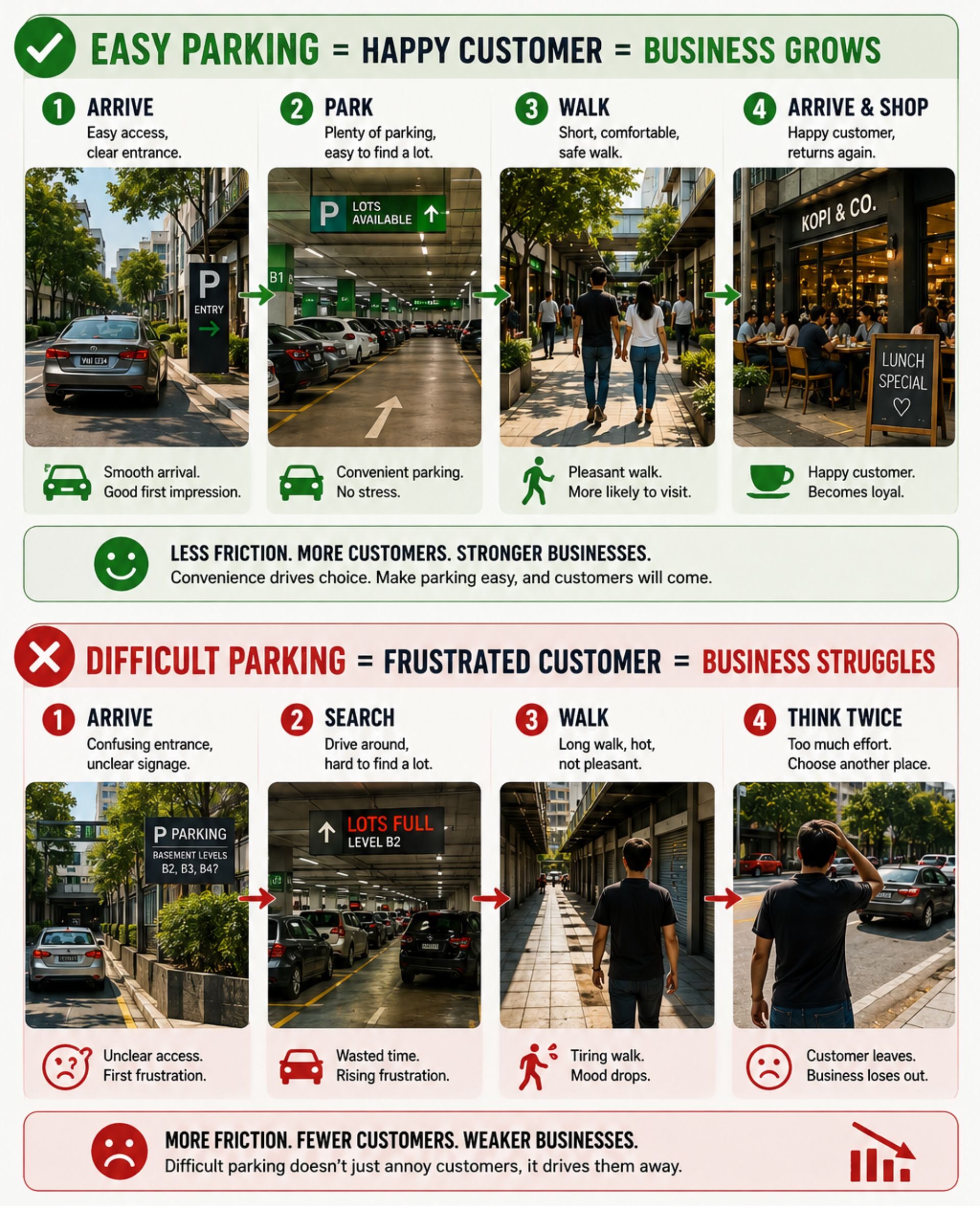
Parking isn’t a supporting feature of retail. Parking is part of the retail experience.
A restaurant may serve excellent food.
A shop may have a brilliant concept.
A clinic may have excellent doctors.
But if getting there feels like a small military exercise, customers may simply go somewhere else.
I’ve noticed how differently people behave when parking is easy.
You drive in.
You find a space.
You walk a short distance.
You finish your business.
You leave.
There is almost no friction.
Now compare that with:
Drive around.
Miss the entrance.
Take the wrong ramp.
Go up another level.
Can’t find a space.
Drive around again.
Finally park.
Walk through a confusing route to find the shop.
Suddenly, buying lunch feels like an expedition.
Customers remember that feeling.
They may never consciously say, “I dislike this development because the parking circulation is inefficient.”
They simply stop coming.
This is one of those details that property buyers sometimes overlook because parking is rarely the glamorous part of a development brochure.
But for retail, convenience often beats aesthetics.
Especially when customers have alternatives.
Visibility Isn’t Just About Signage
A shop can be technically visible and still be commercially invisible.
That sounds contradictory, but it happens all the time.
A tenant may have a beautiful sign.
An expensive renovation.
A striking façade.
Great branding.
And yet hardly anyone notices the business.
Why?
Because visibility isn’t simply about whether people can see the shop.
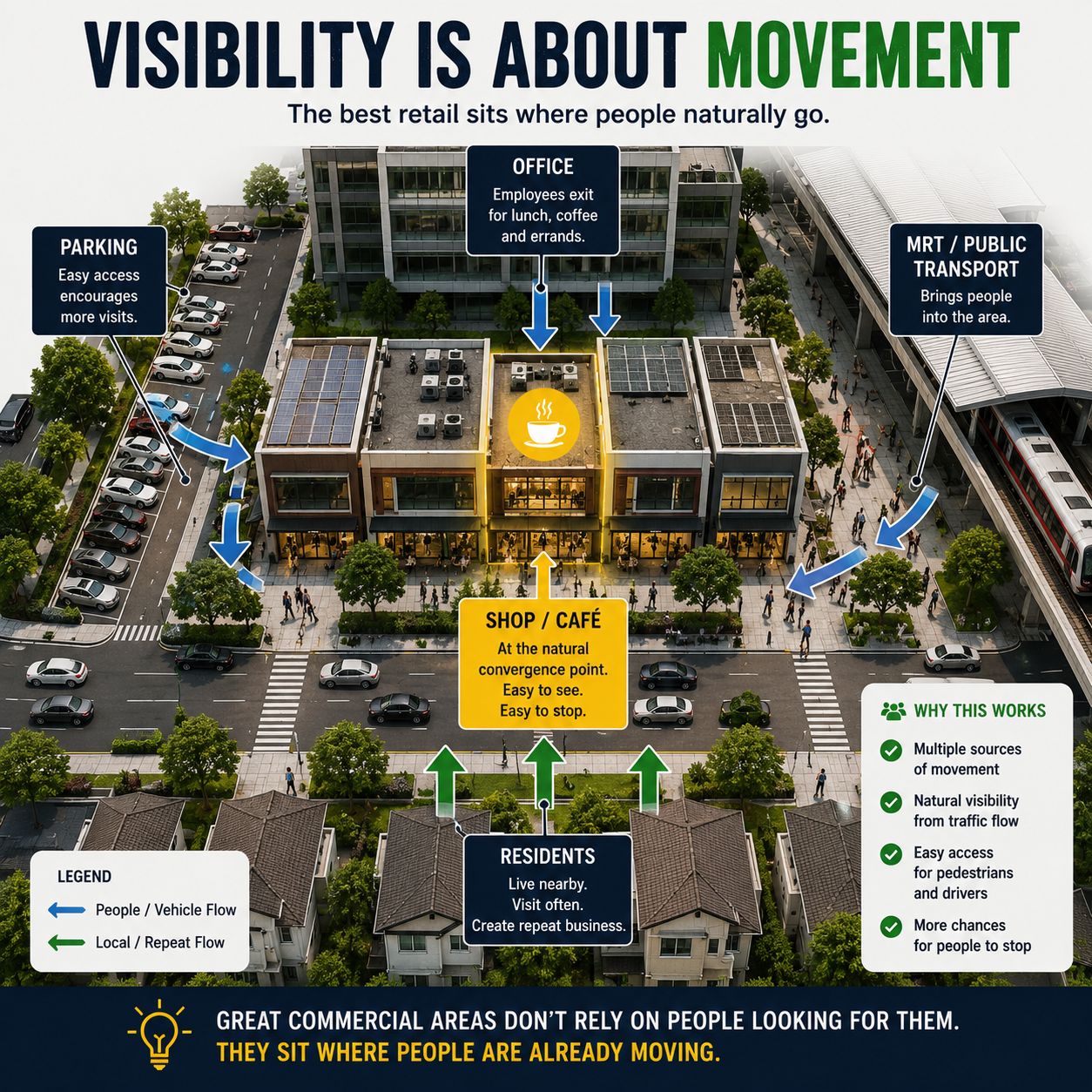
It’s about whether people are moving past it with enough time and intention to notice it.
The best retail locations often sit along natural movement points.
Near entrances.
Near turning points.
Near drop-off areas.
Near pedestrian crossings.
Near lifts and escalators.
Near office exits.
Near parking routes.
Near places where people naturally slow down.
That’s different from simply putting a shop beside a road and calling it “high visibility.”
Good commercial planning understands movement.
Great commercial planning understands behaviour within movement.
Where do people accelerate?
Where do they slow down?
Where do they wait?
Where do they turn?
Where do they naturally look?
These small behavioural details can make an enormous difference to a tenant.
The Weekday Lunch Test
If you want to understand the health of a commercial hub, don’t only visit on Saturday evening.
Go on a Tuesday.
Try between 12PM and 2PM.
That’s when things get interesting.
Look around.
Are office workers actually walking to the restaurants?
Are tables turning?
Are takeaway orders moving?
Are delivery riders waiting outside?
Are convenience stores getting regular customers?
Are people having lunch and immediately leaving, or are they staying and spending more time in the area?
Most importantly:
Does the crowd look like it belongs there?
There is a difference between genuine recurring activity and temporary excitement.
A weekend crowd can be impressive.
A launch event can create photographs that make a development look packed.
A popular café can attract people from across the city.
But sustainable commercial activity comes from repeatable demand.
Monday.
Tuesday.
Wednesday.
Thursday.
Friday.
The boring days are often the most revealing.
A restaurant tenant doesn’t need a spectacular Saturday if Monday to Friday is consistently healthy.
A neighbourhood service business doesn’t need thousands of visitors.
It needs the right people to come back regularly.
That’s why I believe weekday behaviour tells us much more about a commercial ecosystem than a busy weekend afternoon.
Pedestrian Flow Is Invisible Infrastructure
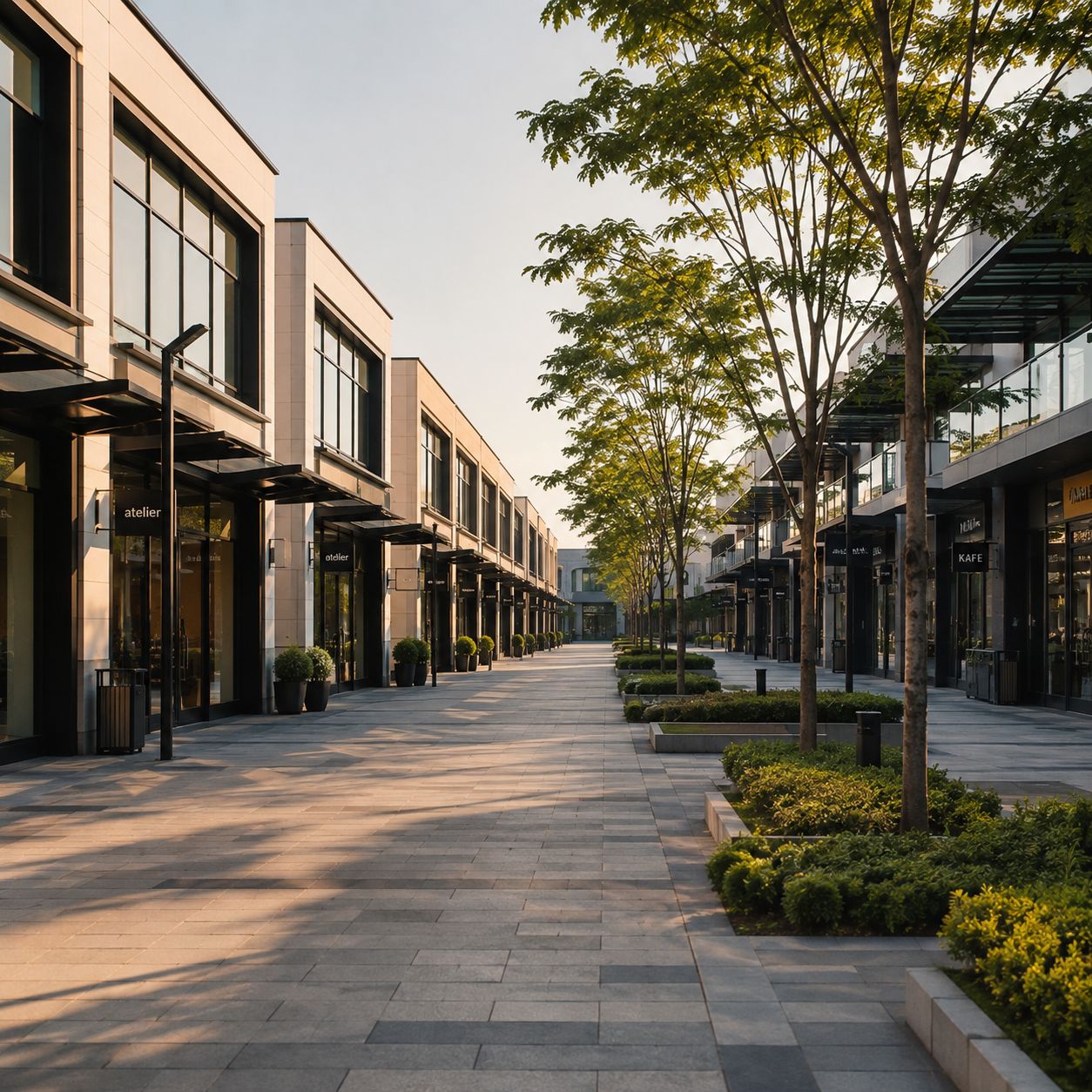
Some commercial developments look wonderful in photographs.
Then you walk through them.
Something feels wrong.
You can’t immediately explain it.
The architecture is fine.
The landscaping is fine.
The shops are fine.
But people aren’t really moving through the space.
Perhaps the walkways are disconnected.
Perhaps the important zones are too far apart.
Perhaps there isn’t enough shade.
Perhaps pedestrians have to cross awkward vehicle routes.
Perhaps the entrances don’t naturally lead people towards the retail areas.
Perhaps the development simply feels too spread out.
This is where pedestrian flow becomes important.
Good retail environments don’t necessarily force people to walk somewhere.
They make the next destination feel obvious.
You arrive here.
You naturally move there.
You notice a café.
You pass another shop.
You see people gathering.
You continue walking.
Before you know it, you’ve travelled through half the commercial area.
That’s good behavioural design.
People don’t feel like they’re being directed.
They’re simply following the easiest, most natural path.
And that movement becomes valuable to businesses along the way.
The Difference Between Footfall and Useful Footfall
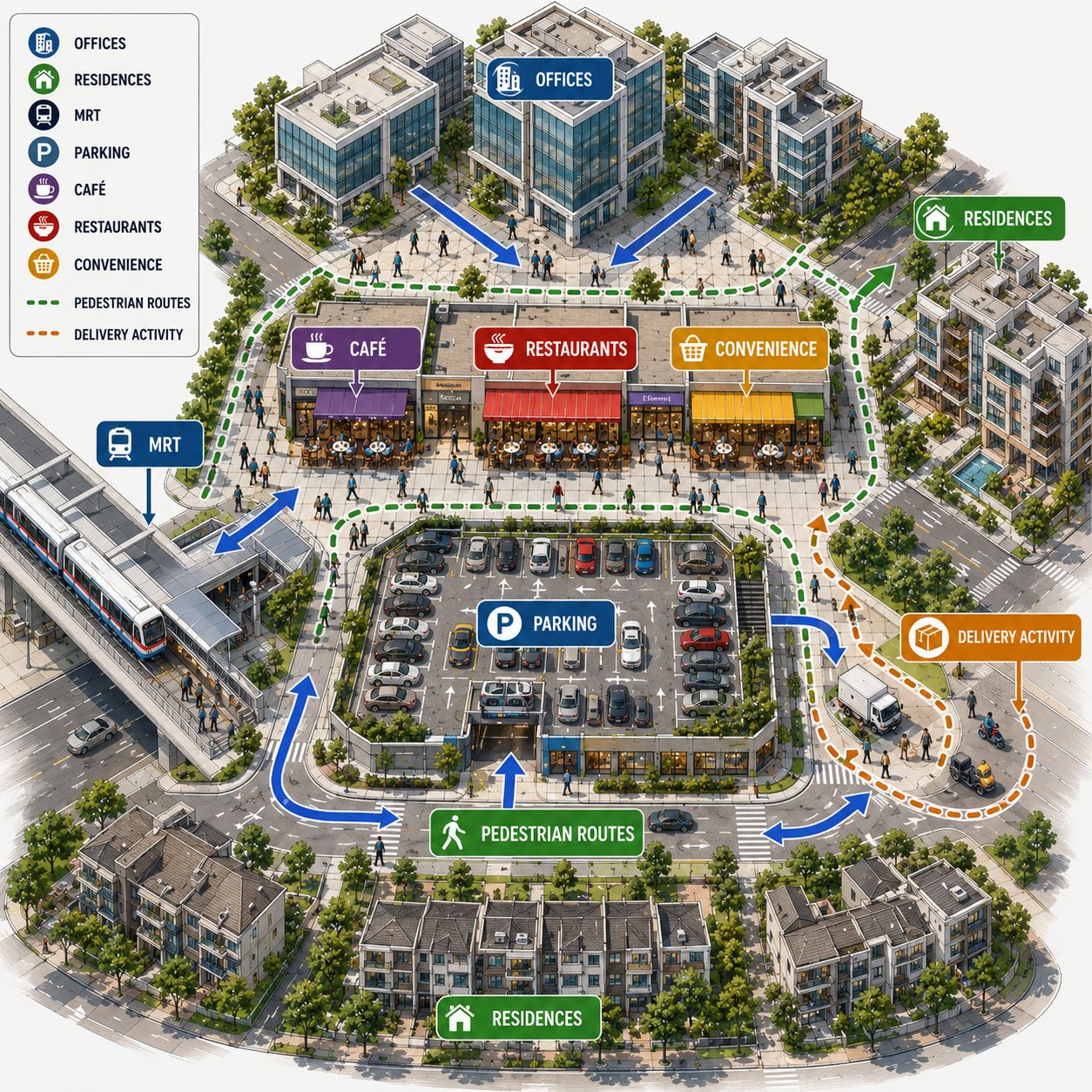
There is another distinction worth making here.
Not all foot traffic is equal.
A hundred people walking past a shop without stopping may be less valuable than twenty people who actually live nearby and visit three times a week.
A commercial property investor should therefore ask a better question than:
“How busy is this place?”
Ask:
“Why are these people here, and will they keep coming back?”
That changes the way you evaluate commercial property.
A café needs morning and afternoon traffic.
A restaurant needs meal-period demand.
A convenience store needs frequent repeat visits.
A dental clinic depends more on catchment population and accessibility.
A tuition centre needs families and students.
A beauty business depends heavily on repeat customers.
A specialist service may need very little spontaneous foot traffic at all.
So the objective isn’t simply to find the busiest commercial area.
It is to understand whether the movement pattern matches the business model.
That’s where commercial property becomes much more interesting.
Why Mixed Developments Can Have an Advantage
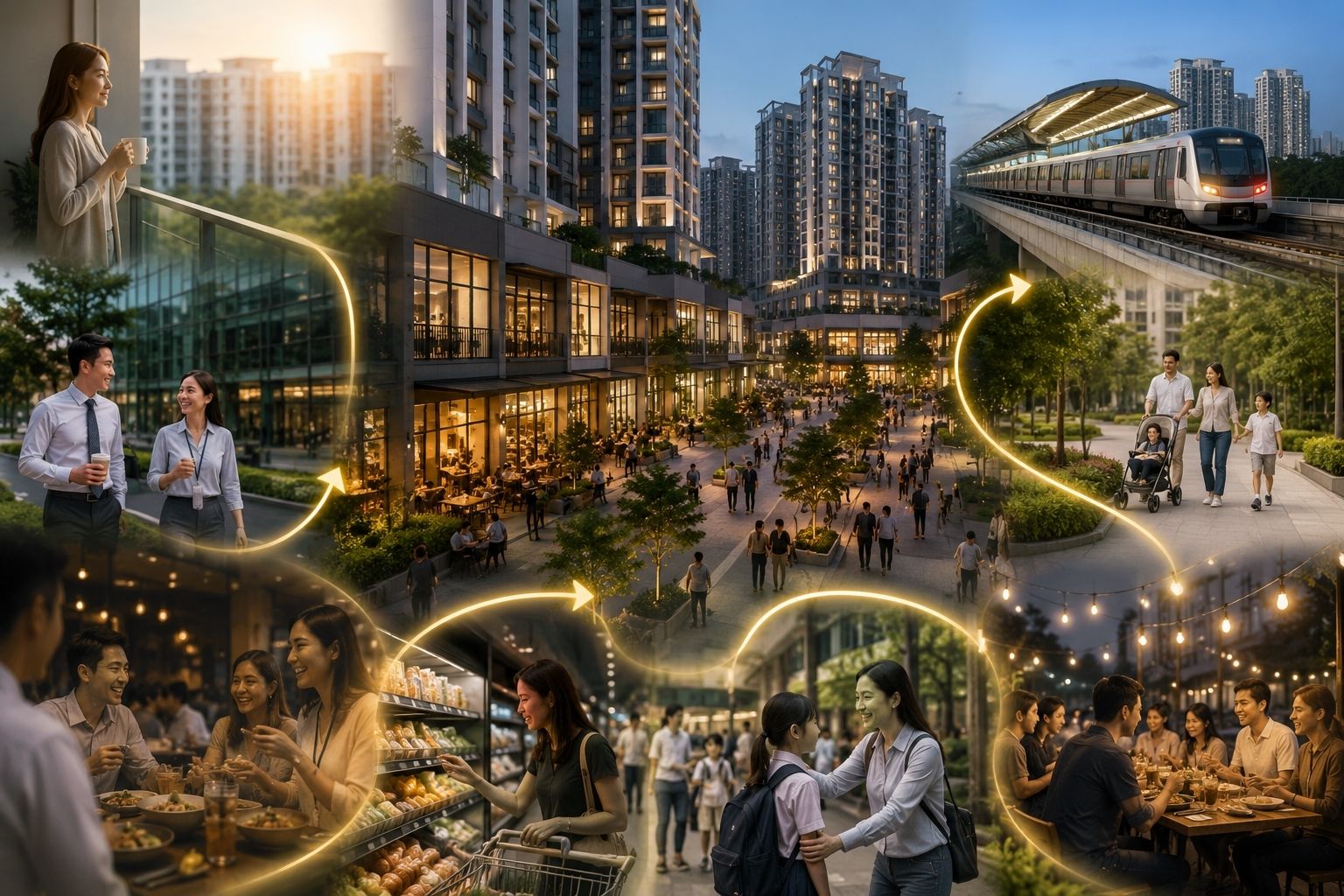
This is also why mixed developments can be fascinating.
When residential, office, retail, lifestyle amenities and transport connectivity support one another, the commercial component has multiple sources of potential activity.
- Morning residents.
- Office workers.
- Lunch crowds.
- Afternoon errands.
- School-related activity.
- Evening residents.
- Weekend families.
The movement doesn’t have to come from one single source.
It can come from several overlapping ecosystems.
That creates something valuable: repeated reasons to be there.
This is one of the reasons I find developments such as Edelweiss @ Tropicana Gardens interesting to watch.
The question isn’t simply whether the shoplots look attractive.
The more important question is whether the surrounding ecosystem can create natural, repeated movement around the commercial component.
- Residential density.
- Office presence.
- MRT connectivity.
- Daily convenience.
- Existing surrounding activity.
These are the ingredients that can potentially create a more sustainable commercial environment.
Of course, none of this guarantees success.
A good location can still be damaged by poor tenant selection.
A strong catchment can still be undermined by weak management.
An attractive commercial area can still struggle if rents become disconnected from what tenants can realistically earn.
And ultimately, businesses still have to deliver a product or service customers actually want.
But a development connected to existing patterns of human movement generally has a stronger foundation than one trying to manufacture activity from scratch.
The Commercial Property Lesson
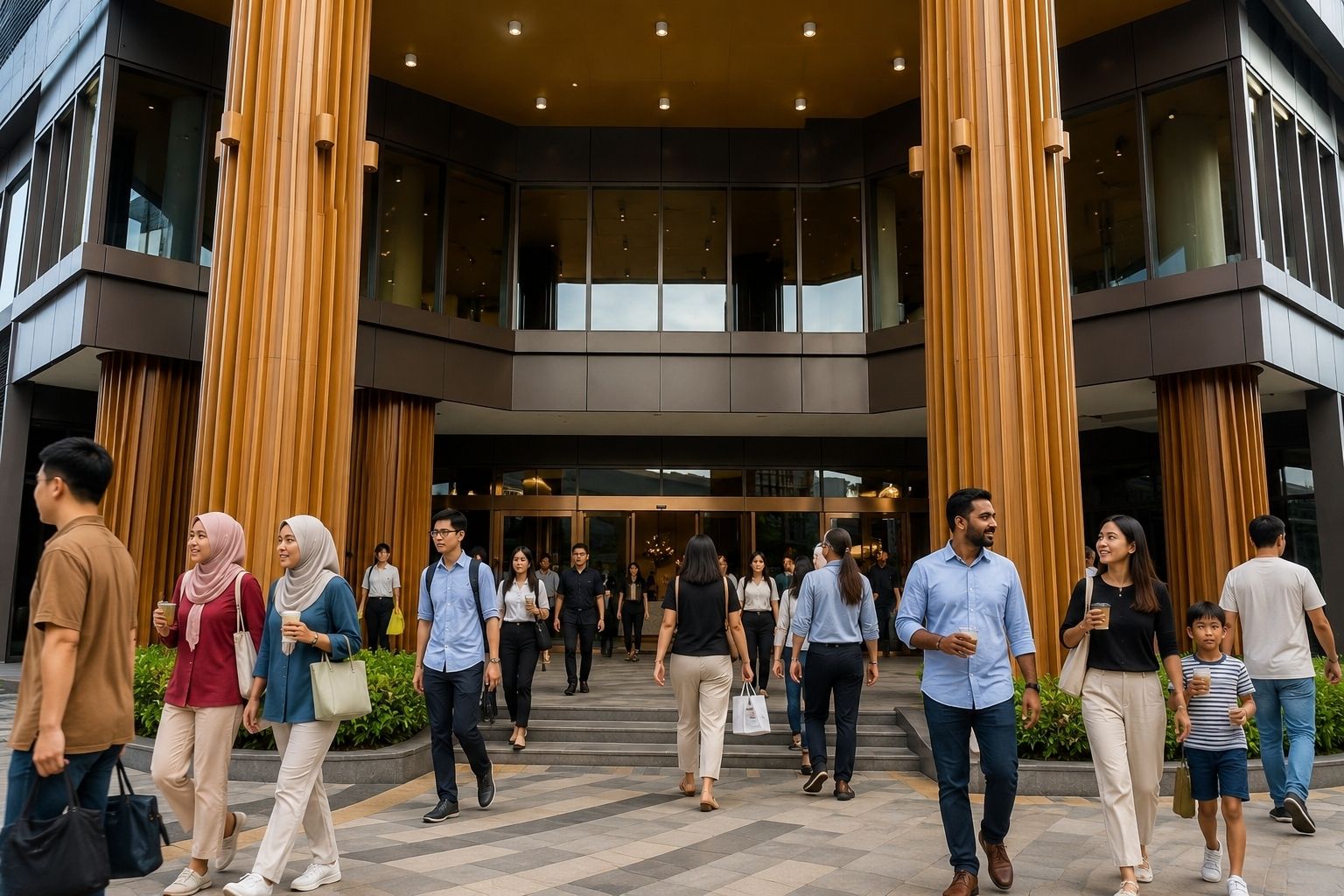
After spending enough time looking at commercial property, I’ve come to think that “location” is almost too simple a word.
What we’re really talking about is movement.
Where people come from.
Where they are going.
What they need along the way.
How easy it is to stop.
How easy it is to park.
How long they stay.
And what makes them return.
The best commercial hubs understand these behaviours almost instinctively.
They don’t necessarily have the most beautiful buildings.
They don’t always have the biggest signs.
They don’t always have the fanciest landscaping.
But they make life easier.
And people reward convenience with something incredibly valuable in retail: habit.
Once a place becomes part of someone’s routine, it stops being just another commercial development.
It becomes their place.
The coffee place.
The lunch place.
The grocery place.
The place to meet friends.
The place to pick something up before going home.
That is when a commercial hub starts to feel alive.
And perhaps that’s the real secret.
Successful commercial property isn’t simply about building somewhere people can go.
It’s about creating an environment where people have a reason to keep coming back.
Because in the end, buildings don’t create commercial activity.
People do.
Disclaimer: This article reflects the author’s personal observations, opinions and analysis of commercial property and market behaviour. Any reference to specific developments, including Edelweiss @ Tropicana Gardens, is intended for discussion and illustrative purposes only and should not be construed as a recommendation, endorsement or guarantee of investment performance. Property investment involves risks, and readers should conduct their own research and seek appropriate professional advice before making any investment decision. Past or current activity in a commercial area does not guarantee future performance.